
— Ben Laube Homes Blog
VA Loans in Florida: A Practical Guide for Veterans Buying a Home
Florida has more active-duty service members and veterans than almost any other state. MacDill Air Force Base anchors the south Tampa peninsula, Patrick Space Force Base sits along the Brevard coast, and NAS Jacksonville covers Northeast Florida. NAS Pensacola anchors the Panhandle. When those service members transition out — or PCS in — a VA loan is usually the first financing question they ask.
This guide covers everything specific to buying a home in Florida with a VA loan: the 2026 funding fee schedule, how to get your Certificate of Eligibility, the Minimum Property Requirements (MPRs) that catch Florida homes more often than you would expect, and the property-tax exemptions that can save disabled veterans thousands per year.
What Makes a VA Loan Different
A VA loan is a mortgage backed by the U.S. Department of Veterans Affairs. The VA does not lend money directly — it guarantees a portion of the loan, which lets approved lenders offer terms that would not otherwise be available to most buyers.
- No down payment required (on most purchases)
- No private mortgage insurance (PMI)
- Competitive interest rates — historically 0.25 to 0.5 percentage points below conventional
- No prepayment penalty
- Lifetime benefit — can be reused after paying off a prior VA loan
- Assumable mortgage — a future buyer can take over your rate if it is lower than current market
The tradeoff is the VA funding fee, a one-time charge that goes toward the VA loan program. I will break that down next.
VA Funding Fee in 2026
The funding fee is a percentage of the loan amount, paid at closing (or rolled into the loan). The rate depends on whether it is your first VA loan, how much you put down, and the loan type.
Purchase loans — 2026 rates
- First use, 0% down: 2.15% of the loan amount
- First use, 5%+ down: 1.50%
- First use, 10%+ down: 1.25%
- Subsequent use, 0% down: 3.30%
- Subsequent use, 5%+ down: 1.50%
- Subsequent use, 10%+ down: 1.25%
Refinance loans — 2026 rates
- IRRRL (streamline refinance): 0.50%
- Cash-out refinance: 2.15% first use / 3.30% subsequent use
On a $400,000 purchase with no down payment, a first-time VA buyer pays $8,600 in funding fee — compared to $8,000+ in PMI per year on a conventional loan with less than 20% down. The math usually favors the VA loan even with the upfront fee.
Who is exempt from the funding fee
Veterans with a VA service-connected disability rating of 10% or higher pay zero funding fee. Surviving spouses of veterans who died in service or from a service-connected disability are also exempt. If your disability rating is pending at closing, you can request a refund after the rating is confirmed.
Getting Your Certificate of Eligibility (COE)
The COE is the document that proves to lenders you qualify for a VA loan. It also shows your available entitlement — the amount the VA will guarantee. You need this before a lender can approve your loan.
Three ways to get your COE
- Through your lender: Most VA-approved lenders can pull your COE directly via the VA Web LGY system in minutes. This is the fastest path for most buyers.
- Online via VA.gov: Log in to VA.gov and request it through the housing benefits section. You will need your DD-214 (for veterans) or statement of service (for active duty).
- VA mobile app: As of March 2026, the VA Health and Benefits app lets eligible veterans view and download an active COE from their phone. The caveat: this only works if a COE is already active in the system. If yours is not, use the lender or VA.gov route.
- By mail (VA Form 26-1880): Takes 4–6 weeks. Only use this if the other options fail.
If you served in the National Guard or Reserve, you need your NGB-22 form in addition to a DD-214 if you were federally activated. The eligibility rules for Guard and Reserve members depend on when and how you served — your lender or the VA website can clarify based on your dates.
Florida-Specific Minimum Property Requirements (MPRs)
Every VA appraisal includes a check of the VA Minimum Property Requirements — the VA equivalent of a home inspection, built into the appraisal. The appraiser flags anything that makes the home unsafe, unsanitary, or structurally unsound, and those issues must be resolved before the loan closes.
Florida has several categories of MPR issues that come up more frequently here than in other states.
Roof condition
The VA does not fail a roof based on age alone. What matters is whether it is weathertight and free of active leaks. In Florida, that means the appraiser looks for missing shingles, soft decking, water stains on ceilings, and any evidence of intrusion. Homes in coastal counties — Hillsborough, Pinellas, Brevard, Duval — get closer scrutiny on hurricane-related wear. If the appraiser conditions the roof, you will need a licensed roofer to repair or replace it before closing.
Wood-destroying organisms (WDO) / termite inspection
Florida is one of the most termite-intensive states in the country — specifically for Formosan subterranean termites in South and Central Florida. The VA requires a Wood Destroying Organism (WDO) inspection (often called a termite inspection) in Florida for all purchase loans. The report must show no active infestation and no structural damage from prior infestation. If damage is found, repairs are required before close.
Cost: WDO inspections typically run $75–$150 in the Tampa Bay area. The VA does not allow the veteran to pay for it under the non-allowable fees rule in some loan scenarios — ask your lender how to structure this.
Well and septic inspections
If the property has a private well or septic system — common in rural Hillsborough County, Pasco, Hernando, and Polk — the VA requires both a water quality test and a septic inspection. The water must meet local or EPA standards for bacteria, nitrates, and chemical contaminants. The septic system must function without backing up, surfacing, or odor. Both must be verified and documented before closing.
This is one of the most common VA loan delays I see on rural Florida properties. Order the water test and septic inspection at the same time as the VA appraisal. Do not wait.
Wind mitigation and insurance
The VA itself does not require a wind mitigation inspection, but your homeowner's insurance lender will. Florida insurers almost universally require a wind mitigation report before binding a policy on coastal properties built before 2002. Without an acceptable policy in place at closing, your loan cannot fund. Get the wind mitigation inspection scheduled early — budget $100–$200 and 3–5 business days for the report.
Pool and fence safety
Florida law requires a barrier (fence, screen enclosure, or approved safety cover) around any residential pool. The VA appraiser enforces this as part of the safety standard. If the property has a pool without a compliant barrier, the seller must install one before closing. This is not negotiable — it is a VA condition tied to Florida state law.
Note: As of May 1, 2026, the VA updated its MPR rules to exclude detached structures — sheds, detached garages — from MPR requirements. A rusted-out storage shed will no longer kill a VA appraisal on its own.
Florida Military Markets: Where VA Buyers Are Active
Understanding the local market around each installation matters because price ranges, commute distances, and HOA restrictions all affect what a VA loan can do for you.
MacDill AFB — South Tampa and surrounding Hillsborough County
MacDill supports over 11,000 personnel on the southern tip of the Tampa peninsula. The 2026 BAH for an E-5 with dependents at MacDill is $2,709/month. South Tampa (Bayshore Beautiful, Beach Park) is desirable but expensive — median prices run $900K–$1.2M, which is above the VA conforming loan limit. Brandon, Riverview, and Ruskin offer better value with 20–35 minute commutes and median prices in the $350K–$475K range where VA zero-down is most practical.
Patrick Space Force Base — Brevard County
Patrick SFB is between Satellite Beach and Cocoa Beach on the Space Coast. Surrounding markets — Melbourne, Palm Bay, Viera, Titusville — see strong VA loan activity and offer median prices mostly under $400,000. Viera is a master-planned community popular with military families. Palm Bay is the most affordable option with the largest inventory. The Brevard market has significant investor activity so moving fast still matters.
NAS Jacksonville — Duval and St. Johns County
NAS Jax is one of the Navy's largest installations. Neighborhoods like Mandarin, Oakleaf, and Fleming Island in Clay County are popular with military families — 20–30 minute commutes with strong school districts and median prices in the $350K–$450K range. St. Johns County (Ponte Vedra, Nocatee) is more expensive but still common for O-4s and above with higher BAH.
NAS Pensacola — Escambia and Santa Rosa County
Pensacola is outside my primary service area, but I get questions about it because the market is very VA-friendly. Gulf Breeze and Navarre in Santa Rosa County offer coastal access with lower price points than Gulf front, typically $275K–$400K. Escambia County is more affordable but has additional flood zone considerations worth reviewing before you make an offer.
Florida Property Tax Exemptions for Veterans
This is the part that most buyers — and a lot of real estate agents — do not fully understand. Florida offers among the most generous veteran property-tax exemptions in the country.
100% permanently and totally disabled veterans
If the VA has rated you 100% permanent and total (P&T), you pay zero Florida property tax on your homestead. No cap on home value. No income test. This is a full exemption. On a $400,000 home in Hillsborough County (millage rate roughly 18–22 mills), that is $7,200–$8,800 in annual savings.
10%+ service-connected disability
Any Florida resident veteran with a VA-certified service-connected disability of 10% or greater qualifies for a $5,000 property tax exemption. This stacks with the standard homestead exemption (up to $50,000 in assessed value reduction). Combined, a qualifying veteran can have up to $55,000 removed from their assessed value before taxes are calculated.
65+ veterans with combat-related disability
Veterans who are 65 or older with a partial combat-related disability get a discount on their homestead property taxes equal to the percentage of their permanent service-connected disability. A 40% disability rating means a 40% discount on the homestead tax bill. This can compound significantly for long-serving veterans with multiple service-connected conditions.
The application deadline for any Florida property tax exemption is March 1 for the current tax year. File with your county property appraiser — not the VA. Bring your VA disability letter, DD-214, and proof of Florida residency as of January 1.
VA Loan Limits in Florida for 2026
If you have full VA loan entitlement — meaning you have never used a VA loan, or you have paid off any prior VA loan and restored entitlement — there is no set loan limit. You can borrow as much as a lender will approve with no down payment.
If you have partial entitlement (an active VA loan elsewhere), limits apply based on the county conforming loan limit. For most Florida counties in 2026, the conventional conforming limit is $806,500. High-cost counties like Monroe (Keys) are higher. Above those amounts, you would need to put down 25% of the difference between the purchase price and the limit.
What to Expect from a VA Appraisal vs. a Regular Inspection
I tell every VA buyer the same thing: get a separate home inspection in addition to the VA appraisal. They serve different purposes. The VA appraisal sets value and checks MPRs. A private inspection goes deeper — HVAC, electrical, plumbing, roof structure, foundation. The appraiser is not your inspector.
In Florida, the private inspection should specifically include: roof inspection with attic access, HVAC condition (units over 15 years old are common and expensive to replace), mold scan, pool equipment condition if applicable, and a four-point inspection report if the home is over 30 years old (some insurers require it before they will write a policy).
FAQ: VA Loans in Florida
Can I use a VA loan to buy a condo in Florida?
Yes, but the condo project must be on the VA-approved condo list. Many Florida condo communities are not on the list — this is a common issue in the Tampa Bay condo market. Check VA.gov's condo search tool before you fall in love with a specific unit. Getting a non-approved project approved is possible but adds 60–90 days to the timeline.
Can I use a VA loan to buy a manufactured home in Florida?
Yes, if the manufactured home is permanently affixed to land you own (or are also buying), titled as real property, and meets VA MPRs. Manufactured homes on leased land do not qualify. In Florida, you also need to confirm the home meets HUD standards — the title and data plate inside the unit confirm this.
Is there an income limit for VA loans?
No income limit. The VA loan is an eligibility-based benefit, not means-tested. However, lenders still underwrite to their own DTI and residual income standards. The VA requires a minimum residual income — money left after all monthly obligations — that varies by family size and region. Florida falls in the South region.
How long do VA appraisals take in Florida?
Typically 10–14 business days in most Florida markets, though the Tampa Bay area has had extended wait times during busy spring buying seasons. Build this into your contract timeline — ask for a 45-day close minimum if you are using a VA loan in a competitive market. Sellers are generally accommodating when they understand the VA timeline upfront.
Can a seller refuse to accept a VA offer in Florida?
Legally, yes — a seller can accept or decline any offer for any non-discriminatory reason. In practice, VA offers in Florida are competitive when presented correctly. The common seller objection is fear of VA appraisal requirements. A strong pre-approval letter, a cover letter explaining the inspection and appraisal timelines, and a clean contract go a long way. I have closed plenty of VA transactions in competitive Tampa Bay situations.
What is the VA funding fee for a disabled veteran?
Zero. Any veteran receiving VA compensation for a service-connected disability — at any rating level — is fully exempt from the funding fee. This is one of the most financially meaningful benefits in the entire VA loan program.
Can I use my VA loan benefit more than once?
Yes. Once you pay off a VA loan, you can restore your entitlement and use the benefit again. You can also have two VA loans simultaneously if your entitlement supports it — for example, a PCS move where you buy in Tampa before selling your previous home in Jacksonville.
Nearby
Neighborhoods featured in this post
 Featured
South Tampa
Tampa
Historic + contemporary mix stretching from Bayshore Boulevard to MacDill. Top-rated schools and walkable village pockets.
 Featured
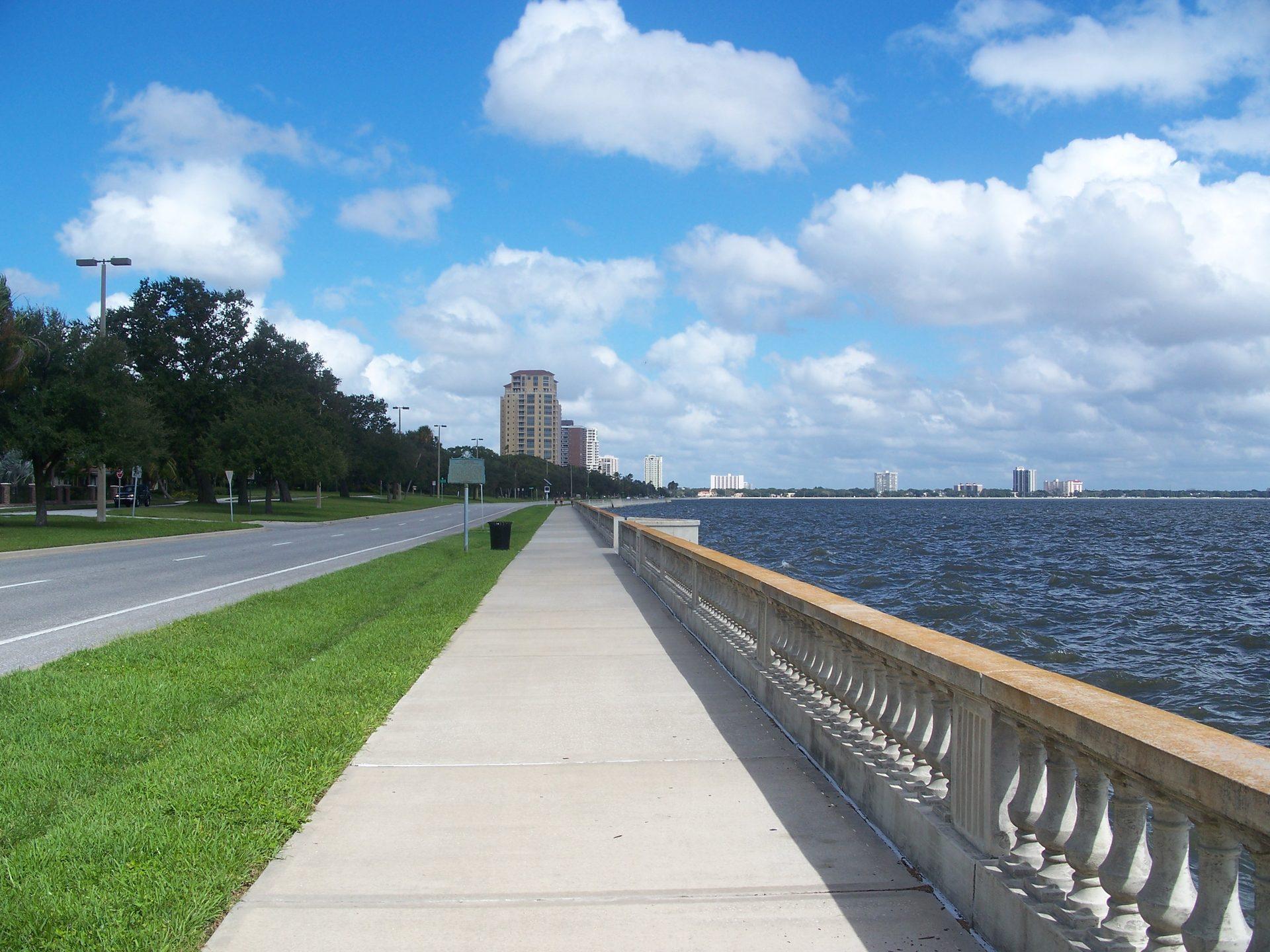
Bayshore Beautiful
Tampa
Bayshore Beautiful lines the eastern shore of South Tampa along Hillsborough Bay — stately homes from the 1920s and 1940s on canopied stree…
Questions about your own market?
Reach out for a tailored take on your neighborhood, timeline, or price band.