
— Ben Laube Homes Blog
Moving to St. Petersburg, FL from Out of State: What to Know Before You Sign
I get calls from out-of-state buyers every week who have decided St. Petersburg is the move. They've watched the videos, they've seen the murals on Central Avenue, they've scrolled the waterfront homes on Snell Isle. What they haven't done yet is price out flood insurance on a canal home in Shore Acres, or figure out which Pinellas County school zones are actually worth paying up for.
This guide covers the questions that matter for a real relocation decision — cost of living, taxes, hurricane and flood reality, neighborhood tradeoffs, and how St. Pete stacks up against Tampa and the beaches. I'm going to give you the version I'd give a friend, not the tourism pitch.
The Tax Situation: No State Income Tax
Florida has no state income tax. If you're moving from New York, California, Illinois, or Massachusetts, this is a real number — not marketing. A household earning $150,000 in New York pays roughly $10,000 to $12,000 in state income tax annually. In Florida, that becomes zero, from the first dollar.
The offset is property taxes, which in Pinellas County run around 1.0 to 1.2% of assessed value for homesteaded properties after your first year. On a $500,000 home, expect $5,000 to $6,000 annually in property taxes. Florida's Save Our Homes cap limits how fast your assessed value can increase — but that protection only kicks in after your first full year, and only after you file for homestead exemption. The year you buy, you pay taxes on the full purchase price, not the prior owner's capped value.
There's no estate tax in Florida either, which matters if you're also thinking about longer-term asset protection.
The $50,000 homestead exemption reduces your assessed value before the tax rate is applied. File by March 1 of the year following your purchase at the Pinellas County Property Appraiser office — you can do it online. Missing the March 1 deadline means you wait another full year.
Cost of Living: Where St. Pete Actually Sits
St. Petersburg is not cheap — at least not the parts most out-of-state buyers want to live in. Downtown, Old Northeast, Snell Isle, and the waterfront neighborhoods have appreciated significantly since 2020. Median home prices in the city run $350,000 to $450,000. Waterfront and historic-district homes start higher: $550,000 to $900,000 in Old Northeast, $700,000 to $2M or more on Snell Isle.
Grocery, restaurant, and utility costs are comparable to mid-size Sun Belt cities. You're not paying Manhattan prices for groceries, but you're also not in rural Florida. Gas averages $0.20 to $0.40 below national averages most of the year.
The honest hidden cost is insurance. Homeowners insurance in Pinellas County runs $2,500 to $5,000 or more per year for a non-flood property in good condition; add $2,500 to $8,000 per year for flood insurance if your home is in Zone AE or VE. On a waterfront canal home, the combined insurance burden can easily exceed $8,000 to $12,000 per year. That's the number most out-of-state buyers miss when they're running their monthly payment calculations.
Hurricane and Flood Reality
St. Petersburg is a peninsula. It's surrounded on three sides by Tampa Bay and the Gulf. That's also why it's beautiful — but hurricane and flood risk are real, not hypothetical. In September 2024, Hurricane Helene sent significant storm surge through low-lying St. Pete neighborhoods including Shore Acres, Venetian Isles, and parts of Coquina Key. Some homes took on several feet of water. In October 2024, Milton followed.
This doesn't mean St. Pete is the wrong choice. It means you need to choose your location within St. Pete with eyes open, and budget for insurance correctly.
Pinellas County FEMA flood maps sort properties into zones. Zone X means you're outside the 100-year floodplain — flood insurance is optional, though still smart. Zone AE means 1% annual flood chance, insurance typically required with a mortgage. Zone VE is coastal high-hazard, with added wave-action risk and the highest premiums.
- Shore Acres, Venetian Isles, Coquina Key: largely AE or VE — real flood exposure, documented post-Helene/Milton damage
- Snell Isle, parts of Old Northeast: AE on lower lots; AE/X mix depending on exact parcel
- Old Northeast (higher lots near 1st Ave NE): many parcels in Zone X
- Pink Streets, Jungle Terrace: mostly Zone X, lower insurance burden
- Disston Heights, North Kenwood, Euclid-St. Paul: Zone X, 30 to 40 feet above sea level
Before you make an offer on any St. Pete property, look up the specific parcel's flood zone on msc.fema.gov and ask your agent to pull the current flood insurance quote. The actual insurance cost on an AE property can swing $3,000 per year depending on the elevation certificate reading.
For the full breakdown of what flood zones mean and how NFIP vs. private flood insurance compares, see our Florida flood zone explainer at /blog/florida-flood-zone-explainer. For the three-layer coverage model covering wind, flood, and Citizens, read our hurricane insurance guide at /blog/hurricane-insurance-guide-florida.
St. Pete vs. Tampa vs. the Beaches: Choosing Your Base
These are different cities with different rhythms. Here's how they actually compare for someone relocating.
St. Petersburg
A real walkable downtown. The Pier, the Dali Museum, the Mahaffey Theater, and Central Avenue's restaurant and bar scene are all pedestrian-accessible from downtown condos and Old Northeast homes. St. Pete has a dense arts district, good coffee, and a culture that punches above the city's size. It's denser and more urban than Tampa in feel. Commute across the bay to Tampa takes 25 to 40 minutes via I-275 during normal traffic, up to an hour in rush hour.
Tampa
Tampa is bigger, more sprawling, and more business-centric. Hyde Park and South Tampa have strong residential neighborhoods with walkability in pockets. The job market is stronger in Tampa — especially for finance, healthcare, and tech. If your job is in Tampa, living in St. Pete means a bay crossing daily. Some people love the separation; some find it exhausting after six months.
The Beaches (St. Pete Beach, Treasure Island, Madeira Beach)
The barrier islands are tourist-heavy, traffic-congested during season from November through April, and carry the highest flood and wind insurance premiums of the three options. They're beautiful, but the tradeoffs are real: single-road ingress and egress, heavy seasonality, and Pinellas County traffic. Great if beach access is your top priority and you work remotely. Harder as a daily commuter base.
Neighborhood Breakdown: Where to Actually Look
St. Pete's neighborhoods are distinct enough that choosing between them is a real decision, not just a price exercise.
Downtown St. Petersburg
Condos, walkability, the Pier, restaurants and bars within two blocks. The downtown condo market ranges from $350,000 for a well-priced one-bedroom to $1.5M or more for a penthouse with bay views. HOA and condo fees vary widely — ask for the reserve study before you make an offer. The downtown vibe is young, urban, and increasingly polished.
Old Northeast
Old Northeast is the neighborhood people picture when they imagine a historic St. Pete bungalow. Brick streets, canopied oaks, 1920s to 1950s architecture ranging from Craftsman to Mediterranean Revival. Walking distance to the waterfront parks along Coffee Pot Bayou. Homes run $550,000 to $900,000 on the lower end, with larger estate properties above $2M. Flood zone varies by block — higher lots near the ridge spine are Zone X; lower lots closer to Coffee Pot can be AE. See the Old Northeast neighborhood page at /st-petersburg-community/old-northeast for block-by-block details.
Snell Isle
Snell Isle is a dredged island directly north of downtown — the peninsula's most consistently upscale residential neighborhood. Brick streets, deep lots, some of the city's finest historic homes alongside newer construction. Open-bay and canal frontage on many properties. Flood zone is largely AE; budget for flood insurance. Price range: $700,000 on the low end for a non-waterfront updated home, $1.5M to $5M or more for waterfront. See the Snell Isle neighborhood page at /st-petersburg-community/snell-isle.
Pink Streets (Jungle Prada Area)
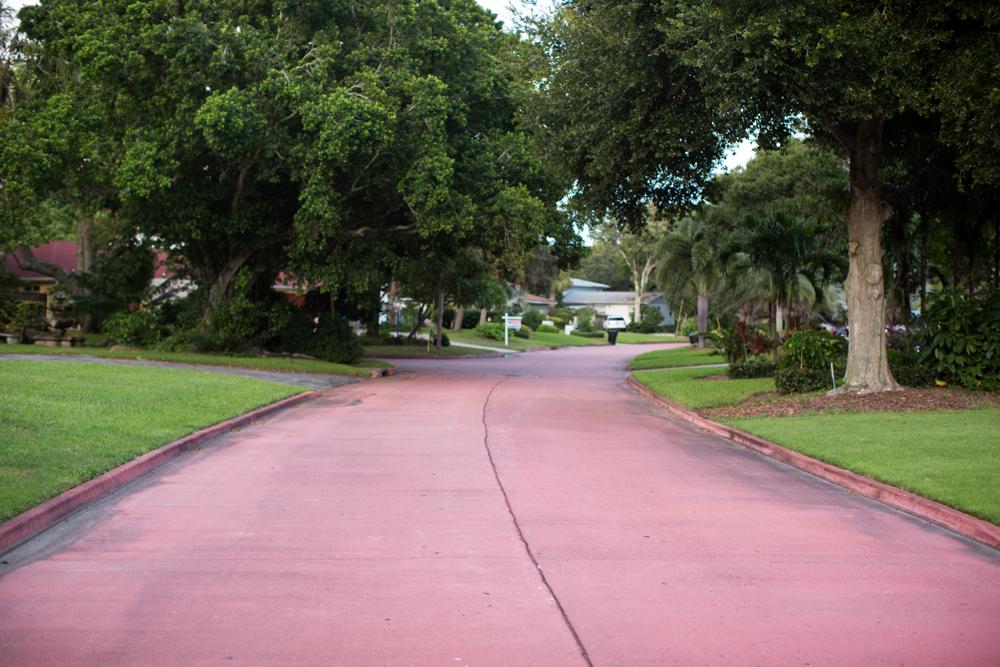
The Pink Streets is the nickname for a grid of streets north of downtown where mid-century block homes built in the 1940s through 1960s line up under dense tree canopy. Pink, yellow, and coral stucco exteriors give the neighborhood its name. Prices are more accessible than Old Northeast — $350,000 to $650,000 for most homes. Flood zone is mostly X, which keeps insurance affordable. The area is quiet and walkable to Jungle Prada de Narvaez park and boat ramp. See the Pink Streets neighborhood page at /st-petersburg-community/pink-streets.
Tropical Shores
Tropical Shores sits on the southeastern edge of the peninsula, bordering Boca Ciega Bay. Canal homes, direct boat access to the Intracoastal. Flood zone is largely AE. The neighborhood is more accessible than Snell Isle waterfront — $450,000 to $900,000 for canal homes — but insurance costs are real. The tradeoff is direct water access at a lower price point than the north-bay neighborhoods. See the Tropical Shores neighborhood page at /st-petersburg-community/tropical-shores.
Pinellas County Schools: What Out-of-State Buyers Get Wrong
Pinellas County Schools is a single unified district covering the entire county. That means there's no moving to a better school district within Pinellas the way you can jump districts in Hillsborough, Orange, or Seminole Counties. The quality variation is school-by-school, not district-by-district.
PCS uses a combination of zoned schools and magnet programs. Well-regarded elementary schools in the central and northeast St. Pete area include North Shore Elementary near the Old Northeast and downtown area, and Perkins Elementary. The district also runs strong magnet programs — Creative Arts to Math and Sciences (CAMS) draws from across the county and is competitive for admission.
The practical advice: identify the elementary school you want before you start your home search, then define your search boundaries from there. Don't assume all of Old Northeast feeds the same school — the boundary line cuts through the neighborhood. Check the current school zone map at the PCS website before making any assumptions.
The Arts Scene, the Pier, and What Makes St. Pete Worth It
St. Petersburg has a legitimate arts and dining scene. The Dali Museum on the waterfront is world-class. The Museum of Fine Arts is two blocks away. The Chihuly Collection is downtown. First Friday gallery walks on Central Avenue draw a real crowd, not just tourists.
The Pier District reopened in 2020 and is genuinely good — a half-mile linear park with food, kayak rentals, fishing, a children's museum satellite, and a real lawn that people actually use. The waterfront trail from the Pier south to Lassing Park is 3 or more miles of bay-front walking and cycling.
The food scene is centered on Central Avenue between downtown and the Grand Central District. The EDGE District has good bars and restaurants too. St. Pete also has a functional airport (PIE — St. Pete-Clearwater International) with Southwest and Allegiant service to major cities, and Tampa International (TPA) is 25 minutes across the bridge.
Before You Make an Offer: The Relocation Checklist
- Pull the flood zone for your specific address at msc.fema.gov — don't rely on neighborhood generalizations
- Get a flood insurance quote before you're under contract, not after
- Order the elevation certificate if the property is in Zone AE — the reading determines your exact premium
- Understand the 4-point inspection requirement: Florida insurers require a 4-point on any home 25 or more years old; knob-and-tube wiring, polybutylene plumbing, or a roof over 15 years old can cause coverage denials
- File for homestead exemption by March 1 of the year after your purchase — the Pinellas County Property Appraiser deadline is firm; missing it costs you the $50,000 exemption and the Save Our Homes cap for an additional year
- Identify your target elementary school before defining your search area — school zone boundaries within St. Pete vary by street
- Visit in June or July before committing — St. Pete in winter is not the same city as St. Pete in summer, and the heat and humidity reality matters for how you'll feel about your neighborhood choice long-term
- Budget for insurance correctly: get a combined homeowners, flood, and wind quote on any specific property you're considering, not a generic estimate
Nearby
Neighborhoods featured in this post
 Featured
Pink Streets
St. Petersburg
Lakewood Estates in south St. Pete, where the streets are literally pink — 4.5 miles of rose-tinted concrete poured in the 1920s that the c…
 Featured
Treasure Island
St. Petersburg
Three miles of Gulf-front beach, a canal-laced interior with private boat docks, and a walkable downtown strip along Gulf Boulevard — Treas…
 Featured
Hyde Park
Tampa
Brick streets, craftsman bungalows, and a walkable village — one of Tampa's most characterful older neighborhoods.
 Featured
Shore Acres
St. Petersburg
Shore Acres is a northeast St. Petersburg peninsula neighborhood where water borders three sides — Old Tampa Bay, Smack's Bayou, and Pappy'…
Questions about your own market?
Reach out for a tailored take on your neighborhood, timeline, or price band.